It's February. Spring is around the corner, and you're staring at a blank content calendar, wondering what to post this week. Meanwhile, your biggest competitor just scheduled three weeks of content, their engagement is up, and they're booking jobs directly from their Instagram. Sound familiar?
Here's the thing about pest control social media ideas: most of the advice out there is painfully generic. "Post educational content." "Engage with your audience." Cool, but what do you post on March 12th when your technicians are slammed, and you have ten minutes between service calls? That's the gap this playbook fills. Over the next 2,500 words, you're getting a week-by-week spring social media plan tied to real pest biology, actual engagement data, and the kind of content that turns scrollers into booked appointments. Whether you're managing a growing team like Sarah Miller at a mid-sized operation or scaling into new markets like David Chen's multi-county business, this calendar is built for pest control companies that don't have time to guess what works. Consider it a companion to our year-round pest control marketing guide; this is where that big-picture strategy becomes Tuesday's Instagram post.

Written By: Hannah Kilpatrick | February 25, 2026
Hannah Kilpatrick Cube Creative DesignHannah Kilpatrick graduated from Western Carolina University in 2021 with a Bachelor of Science in Communication with a Minor in Marketing and a Concentration in Public Relations. She has been around social media since its creation. (Meaning, she was in the first grade when Facebook became available to the general public.) As our very own professional Gen-Z, Hannah is a whiz when it comes to social media creation and paid advertising.
If you're dividing your annual PPC budget by 12 and calling it a strategy, you're bringing a flyswatter to a chainsaw fight.
That "peanut butter" approach (spreading budget evenly across every month) is one of the most expensive mistakes in pest control PPC. It means you're spending the same amount in December, when homeowners are thinking about holiday lights, as you are in May, when those same homeowners are frantically Googling "ants in my kitchen" at 7 a.m. on a Monday. Your $5,000 monthly budget exhausts itself by mid-morning during a May termite swarm, handing the afternoon's highest-intent leads to competitors. Meanwhile, that same $5,000 sits largely unspent in January.
The fix isn't complicated, but it does require a fundamental shift in how you think about pest control PPC in the spring. Your ad spend needs to follow the bugs, not the calendar. Pest biology creates a demand curve that looks nothing like a straight line; it looks like a hockey stick from March through May and a slow decline through fall. Your budget architecture should mirror that curve.
This guide walks through the pre-season framework: how to structure your budget around biological triggers, set bid adjustments that respond to weather events, build a keyword architecture that separates panic traffic from browsing traffic, and time every phase of preparation so your campaigns are loaded and ready before the first swarm hits.

Written By: Chad J. Treadway | February 23, 2026
Chad is a Partner and our Chief Smarketing Officer. He will help you survey your small business needs, educating you on your options before suggesting any solution. Chad is passionate about rural marketing in the United States and North Carolina. He also has several certifications through HubSpot to better assist you with your internet and inbound marketing.
If you run a pest control company, you already know termite work pays well. A single treatment generates more revenue than a quarter's worth of general pest control visits. The bond renewal keeps the customer on your books for years, sometimes decades. And yet, most pest control companies treat termite marketing the same way their customers treat termite prevention: they ignore it until the swarm is in the living room.
That reactive approach leaves money on the table. While you're scrambling to answer the phone in April, the companies that planned their termite marketing ahead of the season are already capturing the highest-value leads in your market. They built their landing pages in January. They primed their email list in February. They aligned their ad spend with swarm biology instead of gut instinct.
This guide lays out a disciplined, year-round approach to termite season advertising that connects your marketing calendar to the biology driving consumer behavior. Whether you're running a growing operation with a handful of technicians or managing a regional team, the framework is the same: respect the biology, educate the consumer, and operationalize retention.
For a broader look at seasonal pest control marketing across all service lines, check out our Year-Round Pest Control Marketing Guide.
Written By: Chad J. Treadway | February 20, 2026
Chad is a Partner and our Chief Smarketing Officer. He will help you survey your small business needs, educating you on your options before suggesting any solution. Chad is passionate about rural marketing in the United States and North Carolina. He also has several certifications through HubSpot to better assist you with your internet and inbound marketing.
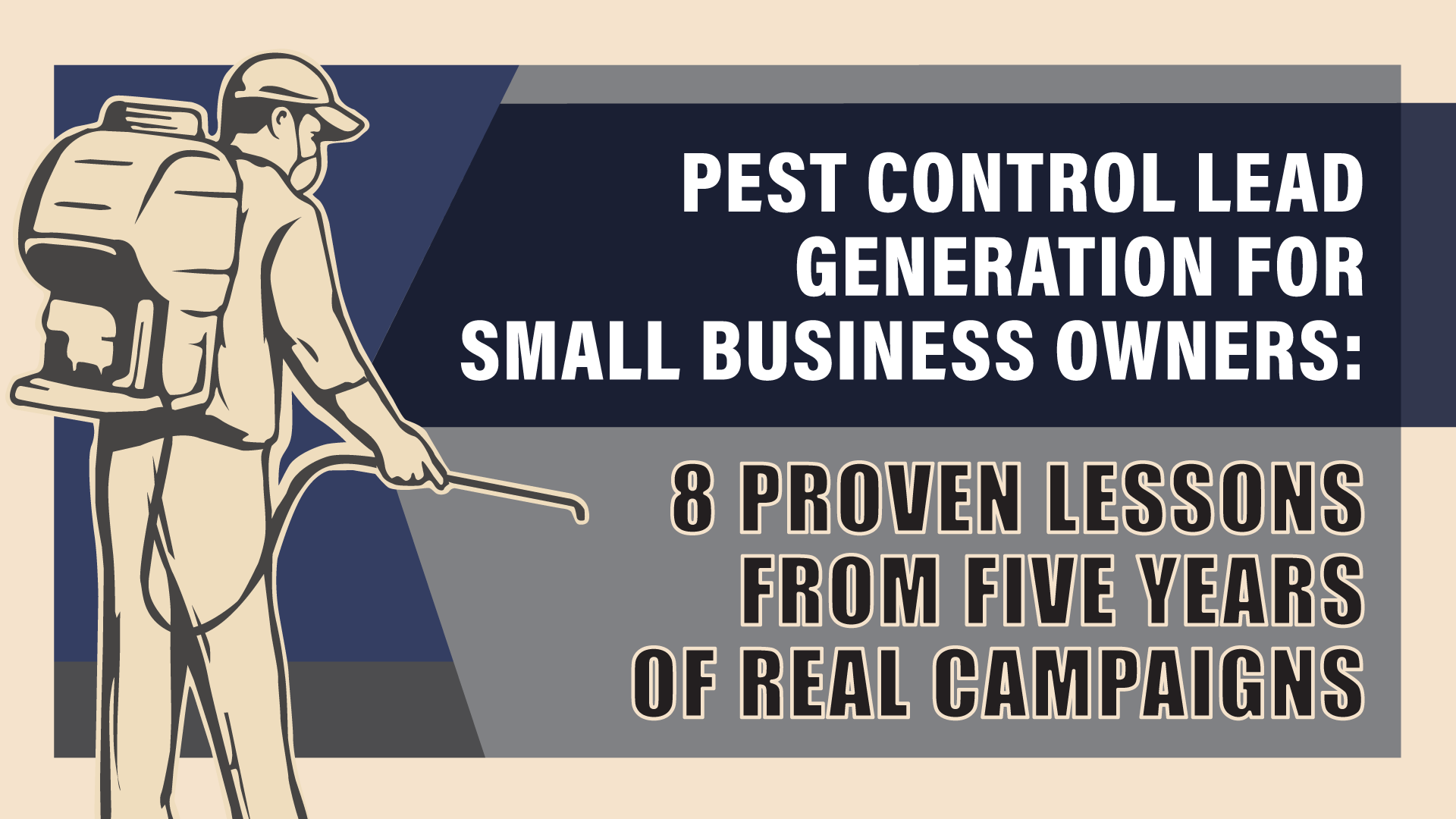
Five years ago, pest control marketing was a simpler game. A decent website, a Google Ads campaign, and a healthy review count could keep most operators busy through peak season. Word-of-mouth referrals filled in the gaps. The phone rang, and you answered it.
That playbook is dead.
Between 2020 and 2025, the pest control industry underwent a transformation that caught a lot of good operators off guard. The market grew. Competition intensified. Advertising costs climbed. And the way customers search for and choose a pest control provider changed in ways nobody fully anticipated. We've had a front-row seat to all of it, building and managing pest control marketing campaigns through a pandemic, a digital advertising inflation surge, and the arrival of AI in search results.
These are the lessons that actually mattered. Not theory from a marketing textbook; real patterns from real campaigns for real pest control companies trying to grow. Some of these lessons cost our clients (and us) real money to learn. Consider this the shortcut.
Written By: Chad J. Treadway | February 18, 2026
Chad is a Partner and our Chief Smarketing Officer. He will help you survey your small business needs, educating you on your options before suggesting any solution. Chad is passionate about rural marketing in the United States and North Carolina. He also has several certifications through HubSpot to better assist you with your internet and inbound marketing.