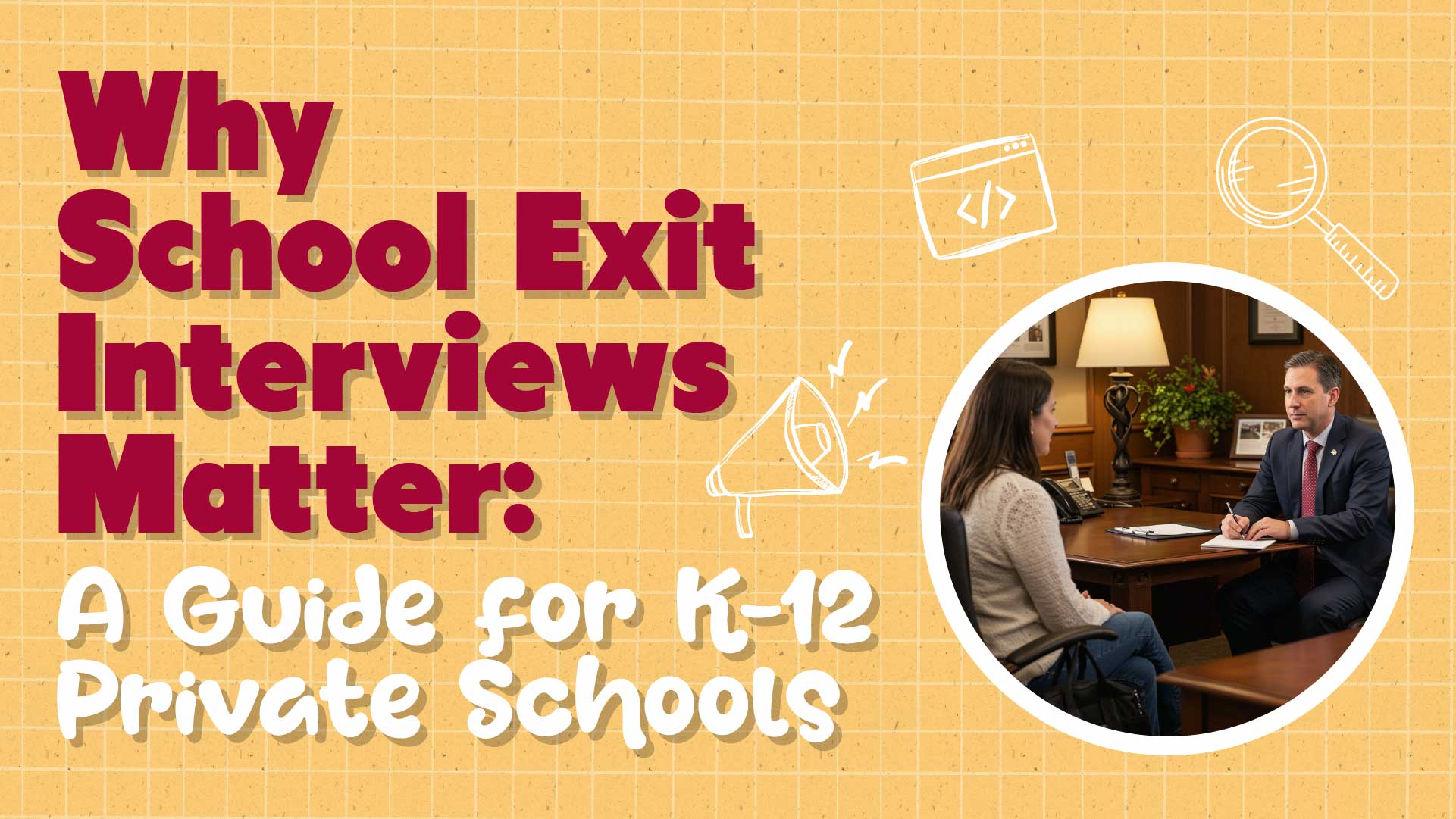
Here is a scenario that plays out every April at private schools across the country: a re-enrollment form comes back blank. No explanation. No phone call. Just silence from a family you assumed was happy. Maybe you saw them at the spring fundraiser two weeks ago, and everything seemed fine. Now they are gone, and you are left wondering what happened.
If this sounds familiar, you are not alone. Data from the Enrollment Management Association (EMA) shows that the median attrition rate for NAIS member schools rose from 7.1% to 8.2% in the years surrounding the Great Recession, driven entirely by voluntary departures. For a faith-based school with 180 students, that means losing 14 to 16 families every single year. Some of those departures are unavoidable (relocations, financial hardship, grade transitions). But some of them were preventable, and the only way to tell the difference is to ask.
School exit interviews are the one tool that turns a departing family into a source of actionable feedback. Think of it like a doctor's visit for your school's health: you cannot treat what you have not diagnosed.

Written By: Chad J. Treadway | April 01, 2026
Chad is a Partner and our Chief Smarketing Officer. He will help you survey your small business needs, educating you on your options before suggesting any solution. Chad is passionate about rural marketing in the United States and North Carolina. He also has several certifications through HubSpot to better assist you with your internet and inbound marketing.
You know that feeling when you drive past a school and the sign out front says something like "Now Enrolling for Fall 2026" in those removable plastic letters? And you think, "That's trying its best." That sign is doing the work of outdoor advertising. It's just doing it with the marketing equivalent of a flip phone.
Outdoor advertising for schools doesn't have to be complicated or expensive. It just has to be visible, targeted, and consistent. For schools operating on lean budgets, outdoor advertising is often the most overlooked tool in the marketing kit, mostly because people assume "outdoor advertising" means renting a billboard on the highway for $5,000 a month. It doesn't have to mean that at all.
Let's talk about what outdoor advertising actually looks like for a school with more ambition than ad budget, and how to make every dollar of it count.
Written By: Chad J. Treadway | March 27, 2026
Chad is a Partner and our Chief Smarketing Officer. He will help you survey your small business needs, educating you on your options before suggesting any solution. Chad is passionate about rural marketing in the United States and North Carolina. He also has several certifications through HubSpot to better assist you with your internet and inbound marketing.
I'm going to say something that might sound old-fashioned: radio advertising still works. Not "works in a retro, nostalgic kind of way." Works as it generates real awareness, drives real inquiries, and costs less per impression than most digital channels.
Before you dismiss radio as something your parents listened to on the way to their office jobs, consider this: Nielsen reports that 84% of American adults tune into radio every week. That's 225 million people. More than watching network TV. More than scrolling Instagram. Radio is America's number one mass reach medium, and for schools marketing to local families, that local reach is exactly what you need.
Here's when radio makes sense for your school, what it costs, and how to make sure it's not just background noise.
Written By: Chad J. Treadway | March 27, 2026
Chad is a Partner and our Chief Smarketing Officer. He will help you survey your small business needs, educating you on your options before suggesting any solution. Chad is passionate about rural marketing in the United States and North Carolina. He also has several certifications through HubSpot to better assist you with your internet and inbound marketing.
Here's a confession that might get my digital marketing card revoked: I think print advertising still works. Not for everyone. Not for everything. But for the right school, targeting the right families, with the right message? A well-timed postcard or a smartly placed community ad can do things that a Facebook campaign simply cannot.
Before you accuse me of going soft, let me be clear. I'm not suggesting you ditch your Google Ads and start buying billboard space. Digital advertising delivers better tracking, broader reach, and lower cost per lead in most situations. We covered that in our complete marketing strategy guide. But for schools rooted in their local communities, print advertising fills a gap that digital often misses.
Let me explain where, when, and how print still earns its place in a school marketing budget.
Written By: Chad J. Treadway | March 25, 2026
Chad is a Partner and our Chief Smarketing Officer. He will help you survey your small business needs, educating you on your options before suggesting any solution. Chad is passionate about rural marketing in the United States and North Carolina. He also has several certifications through HubSpot to better assist you with your internet and inbound marketing.