As a small business owner, you know the importance of building your brand recognition and attracting new clients. Just because your business may be smaller, but that doesn't mean that your client list has to be.
You may be asking yourself, what is lead generation, and how will it help my small business?
Lead generation is a simple concept that refers to the methods and procedures used by small businesses to generate interest in their products or services among prospects and then convert them into clients.
In other words, and as it relates to the online world, it is about getting people interested in your business enough to reach out, allowing you to sell the product or service, thus becoming a valued client.
You may also want to think about it as a process of identifying potential consumers based on their activities. This may include their intent level or how interested they are. Are they just “kicking the tires,” or do they have cash in hand and are ready to buy. If they are “just looking,” it becomes the process of guiding them through the funnel until they become clients.
You and I know that solid relationships with your clients are the heart of a successful small business. With the introduction of new digital and social technologies, the number of ways to generate new leads is constantly evolving as well.

Written By: Adam Bennett | December 20, 2021
Adam is the president and founder of Cube Creative Design and specializes in private school marketing. Since starting the business in 2005, he has created individual relationships with clients in Western North Carolina and across the United States. He places great value on the needs, expectations, and goals of the client.
In today's marketing landscape, influencer marketing is one of the most potent marketing methods for small businesses, brands, and enterprises.
According to Linqia's The State of Influencer Marketing Report, 57% of respondents said: "influencer content outperformed brand-created content" in 2019.
While influencer marketing is still a growing industry, and the statistics have risen since then.
Working with influencers can assist your small business in overcoming common barriers to promotion, such as the use of advertisements.
In this post, I'll discuss six advantages of influencer marketing for small businesses.
What Exactly Is Influencer Marketing?
Sprout Social defines influencer marketing as,
a type of social media marketing that uses endorsements and product mentions from influencers–individuals who have a dedicated social following and are viewed as experts within their niche. Influencer marketing works because of the high amount of trust that social influencers have built up with their following, and recommendations from them serve as a form of social proof to your brand’s potential customers.
(Source: What is influencer marketing: How to develop your strategy)
If you want a completely different take albeit interesting take on social media influencers be sure to check this episode of the podcast Nice to Meet You. In this episode, Professor Burkhead's Unifier beams a Meerkat and a Social Media Influencer to his space station. As silly as it sounds it is an interesting take on them and is entertaining in the least.
The bottom line is that influencer marketing focuses on employing influential individuals (aka influencers) to transmit a company's message to relevant, broader markets.
It combines the use of traditional and modern marketing tactics. It combines the concept of celebrity endorsement with exclusive content and internet promotions.
As a small business owner, you will most likely want to work directly with one or more influencers to convey your message across their social media accounts.
Influencers can help link customers to companies by influencing others' attitudes and motivating them to take action on a given topic.

Written By: Hannah Kilpatrick | December 15, 2021
Hannah Kilpatrick Cube Creative DesignHannah Kilpatrick graduated from Western Carolina University in 2021 with a Bachelor of Science in Communication with a Minor in Marketing and a Concentration in Public Relations. She has been around social media since its creation. (Meaning, she was in the first grade when Facebook became available to the general public.) As our very own professional Gen-Z, Hannah is a whiz when it comes to social media creation and paid advertising.
Did you know that most business-to-business (B2B) researchers and buyers use the internet to acquire information about possible purchases; according to a report by Google, it is 89%! With so many prospective clients starting their search on the internet, businesses of all sizes need to push their sites to the top of search engines as quickly as possible. Of course, Google Ads provides an immediate solution as SEO efforts begin to take hold, but Google Ads also poses a unique challenge with its own set of considerations.
As part of your inbound marketing strategy, you may choose to run Google Ads. For the most part, inbound marketing focuses on organic traffic, whereas PPC offers an opportunity for instant gratification while your other strategies build.
Larry Kim of WordStream says this about PPC and Inbound Marketing:
PPC is absolutely a part of inbound marketing by my standards. My definition of inbound revolves around being somewhere with the answer when someone is looking for it, NOT sticking an advert for a product or service in front of their faces. That absolutely includes PPC!
(Source: News Flash: PPC Is Inbound Marketing )
Combining SEO and PPC will comprise approximately 90 percent of clicks across the web, so it’s no wonder that businesses are taking advantage of Google Ads!
While running and developing a Google Ads campaign is relatively straightforward. There are still great opportunities for mistakes. You must avoid them if you want your inbound marketing campaign to be successful.
Written By: Adam Bennett | December 08, 2021
Adam is the president and founder of Cube Creative Design and specializes in private school marketing. Since starting the business in 2005, he has created individual relationships with clients in Western North Carolina and across the United States. He places great value on the needs, expectations, and goals of the client.
Building brand awareness and exposure is critical for small businesses. Your business may not be able to bring in more prospects if they don't know you exist. Search engine optimization (SEO) is part of a strong foundation for local small business success and is one of the most effective methods for increasing the visibility of your small business.
When your prospects are searching for a product or service on Google, you need to be visible to them. That’s where local small business SEO can help you. In layman's terms, it is a tactic that can help your website appear at the top of search engine results pages (SERPs).

Written By: Chad J. Treadway | December 06, 2021
Chad is our Chief Smarketing Officer. He will help you survey your small business needs, educating you on your options before suggesting any solution. Chad is passionate about rural marketing in the United States and North Carolina. He also has several certifications through HubSpot to better assist you with your internet and inbound marketing.
Before I answer the question posed in the title of this post, think let me ask you, dear reader, a couple of questions. Do you check reviews before you visit or reach out to a business? Have you ever found yourself favoring one business over another due to their online reviews?
I am sure you could answer yes to both of these questions. Now back to the question I posed in the title of this post and its accompanying answer, which is overwhelming YES! Yes, Google Reviews will help your both general SEO and Local SEO.
Now, this begs the question of how do these local businesses show up on the search results pages (SERPs) in the first place? Well, that’s Local Search Engine Optimization (SEO) at work.
In this article, I will help you better understand what local SEO is and its benefits. I’ll also show you how to use Google reviews SEO to improve your local rankings.
How to Use Google Reviews for Better Local SEO
According to a Review Trackers report, 63.6% of consumers say they are likely to check Google reviews (through Google Maps and Search) before visiting a business location — more than any other review site.”

(Source: Online Reviews Statistics and Trends: A 2021 Report by ReviewTrackers)
What are the benefits of local SEO?
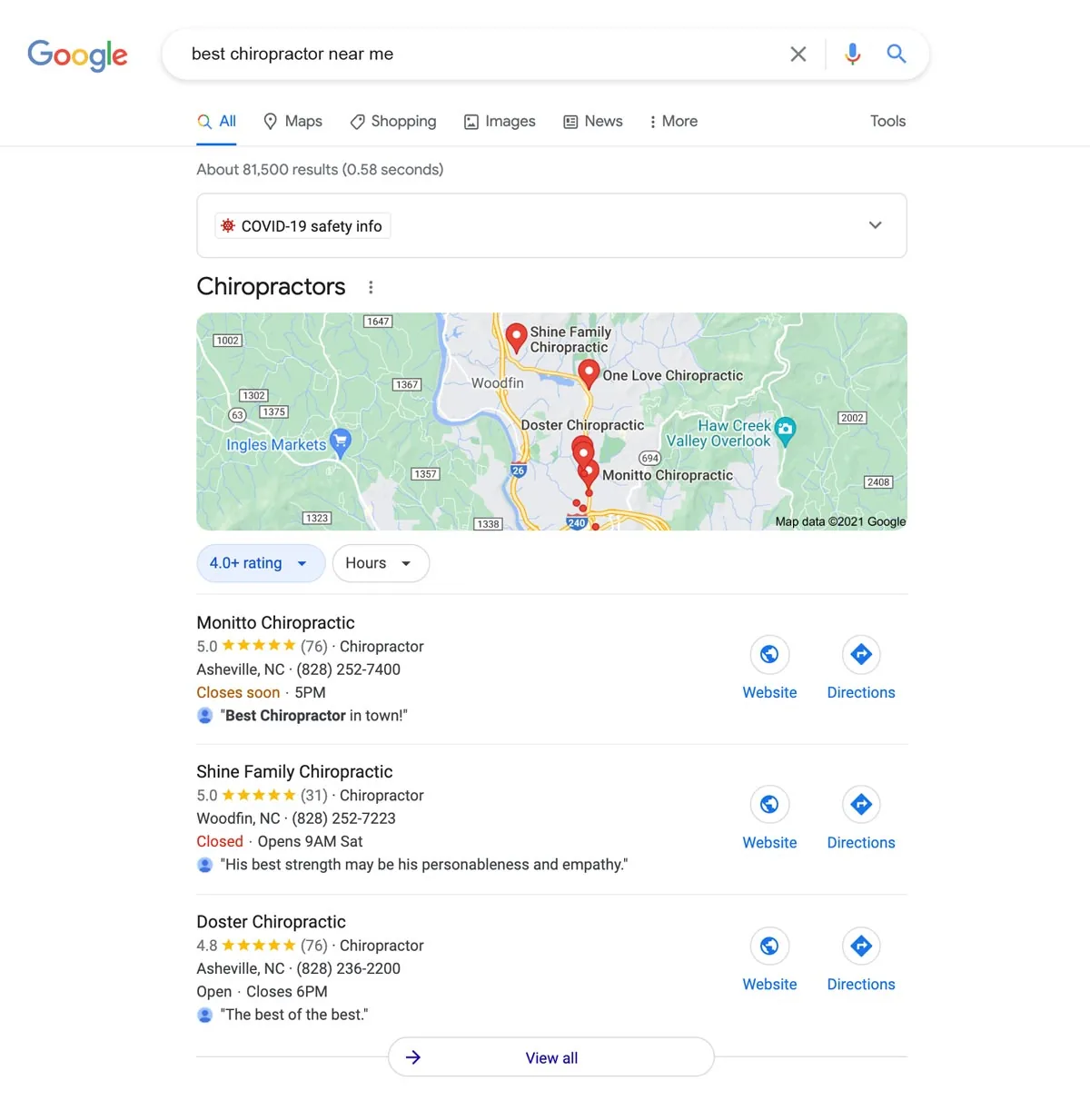
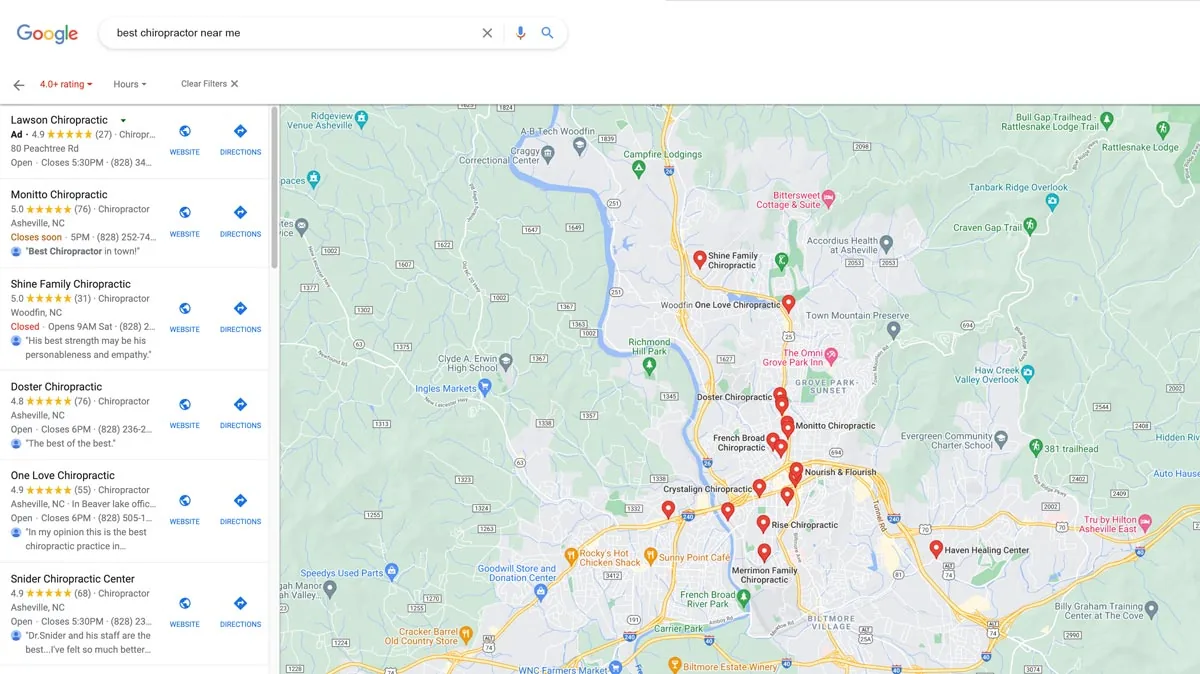
Simply put, Local SEO is about helping your small business rank for specific services in a given geographic area. For example, when you search for “best chiropractor near me” or even “best chiropractor,” several will show up on the (SERPs) like this:
Google Search For "best chiropractor near me"
Google Search For "best chiropractor near me" Map View
Source: Google Searches
The businesses listed in these results have optimized their websites for local SEO. Furthermore, by ranking higher, these establishments benefit from increased brand awareness, which leads to increased traffic and potential clients.
Local SEO is especially critical for brick-and-mortar businesses. Many shoppers look for local companies online before going to the store.
In 2016 Think With Google released a study entitled, “Mobile Shopping Trends and Consumer Behavior.” In it, they state that “76% of people who conduct a local search on their smartphone visit a business within 24 hours and 28% of those searches result in a purchase.”
Now Local SEO is only for brick-and-mortar stores. Service area businesses can and should use this same strategy to target their ideal clientele in the specific locations and areas they service.
By focusing on a specific location using Local SEO, you can efficiently circumvent the competition and increase the visibility of your brand and services.
Leverage Customer Reviews for Local SEO
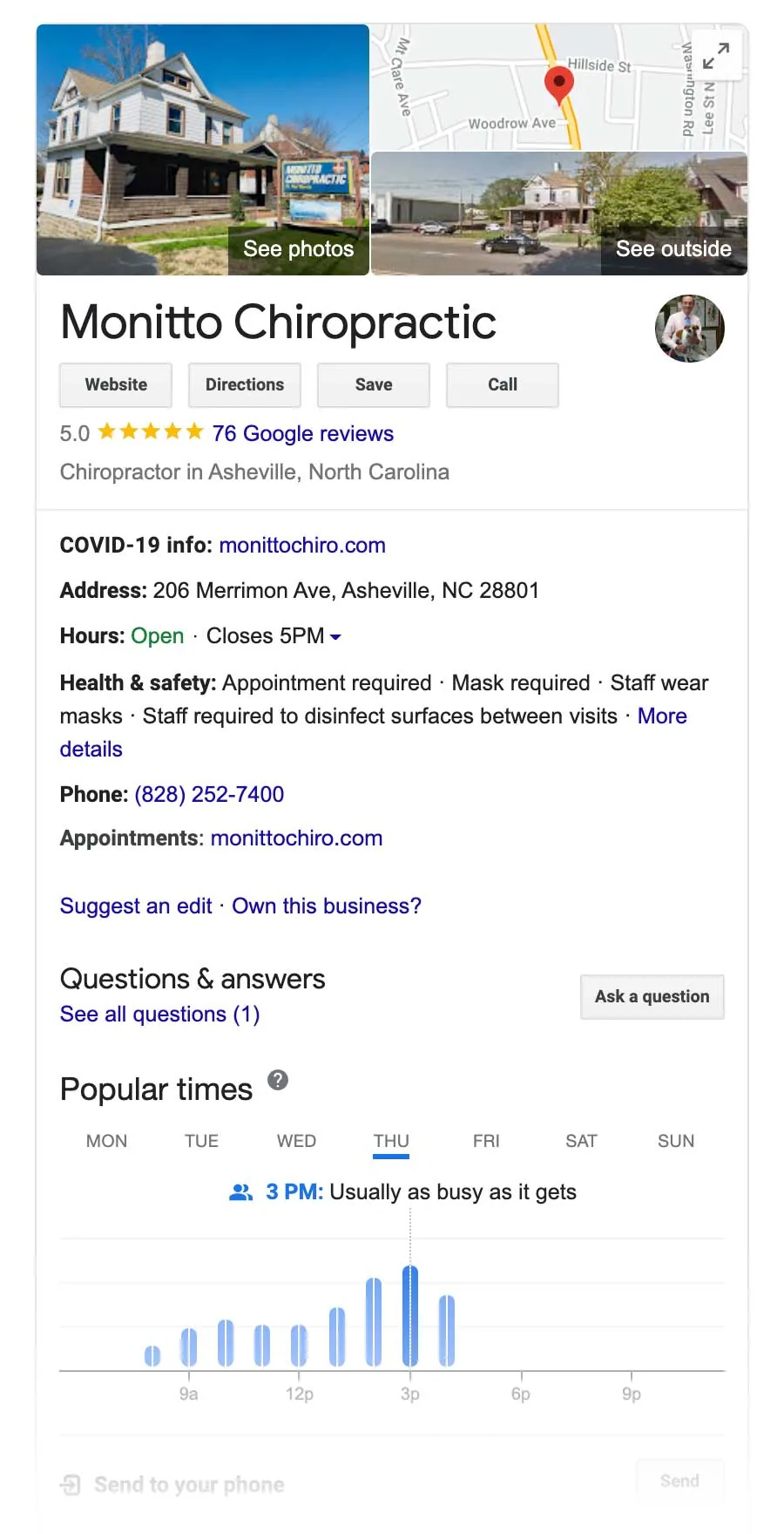
You may be asking yourself, what is the best way to leverage my customer reviews for local SEO strategy? Now that we better understand what local search engine optimization is and why your small business needs it, let’s look at using these online reviews to boost local SEO.
Create a Google Business Profile for Your Business
As you start working on your Google Business Profile (GBP), you may see references to Google My Business (GMB), which was referred to until recently.
Barry Schwartz of Search Engine Land provides a bit of background on the change saying.
[that Google would be] renaming Google My Business to Google Business Profile, as it moves efforts to bring more of the business profile management out of the Google My Business app and directly into Google Search, Google Maps, and those respective apps.
Regardless of what Google wants to call it, the bottom line is that setting up your GBP is most likely the simplest approach to use to help you get client reviews for local SEO strategy. It's also completely free.
Google Business Profile shows key details regarding your business. It may show your opening hours, location, services, etc.
The easily-accessible information makes it easier for prospective clients to engage with your business. And if you optimize your GBP listing correctly, the profile will attract more clients and raise your ranking on the SERPs.
So here are some tips on how to optimize your GBP listing:
- Claim your profile
- Include your contact details
- Use high-quality images, logo, trucks, storefront, etc
- Include any relevant keywords
- Allow customers to message you
- Choose the right business category
- Use Google posts to keep your profile fresh and “clickable.”
- Fill out every section
A Google Business Profile generates more client reviews and helps you utilize the existing reviews to attract clients and boost your rankings. So head over to Google Business Profile and set up your profile, or if you need help, I will be happy to help you for FREE!
Reviews Influence Your Google Ranking
Most small business owners realize the impact of reviews on conversions. Your prospective clientele are more likely to buy or engage services from your business if it has glowing ratings.
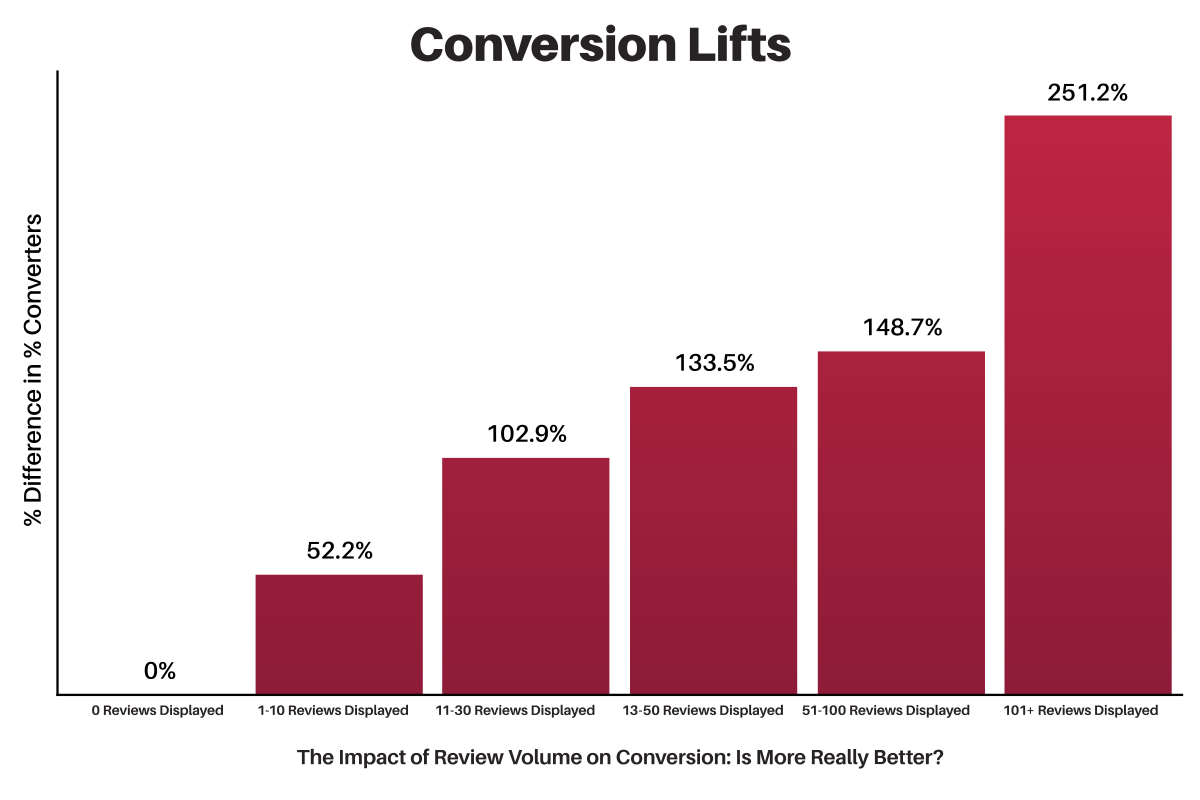
(Source: The Impact of Review Volume on Conversion: Is More Really Better?)
What most small business owners may not realize is that reviews have a direct impact on your rankings. Google, like every other business, strives to provide the greatest possible user experience. So, why would they present a business with a high number of bad reviews when there is another alternative with a high number of positive ones?
Customer reviews indicate how satisfied buyers are with a company, and search engine algorithms understand this. As a result, companies with the most positive reviews have a massive advantage.
Other contributing factors include the overall diversity of sources, the number of reviews, and how recent the reviews are. Therefore, your local search engine ranking will increase if you have diverse reviews and attract lots of positive ones. Also, the newer they are, the better.
Do you require a certain number of reviews?
A 2018 research study conducted by Bright Local said that:
“Local businesses who rank in the top 3 positions in Google Local have an average of 47 Google Reviews.”
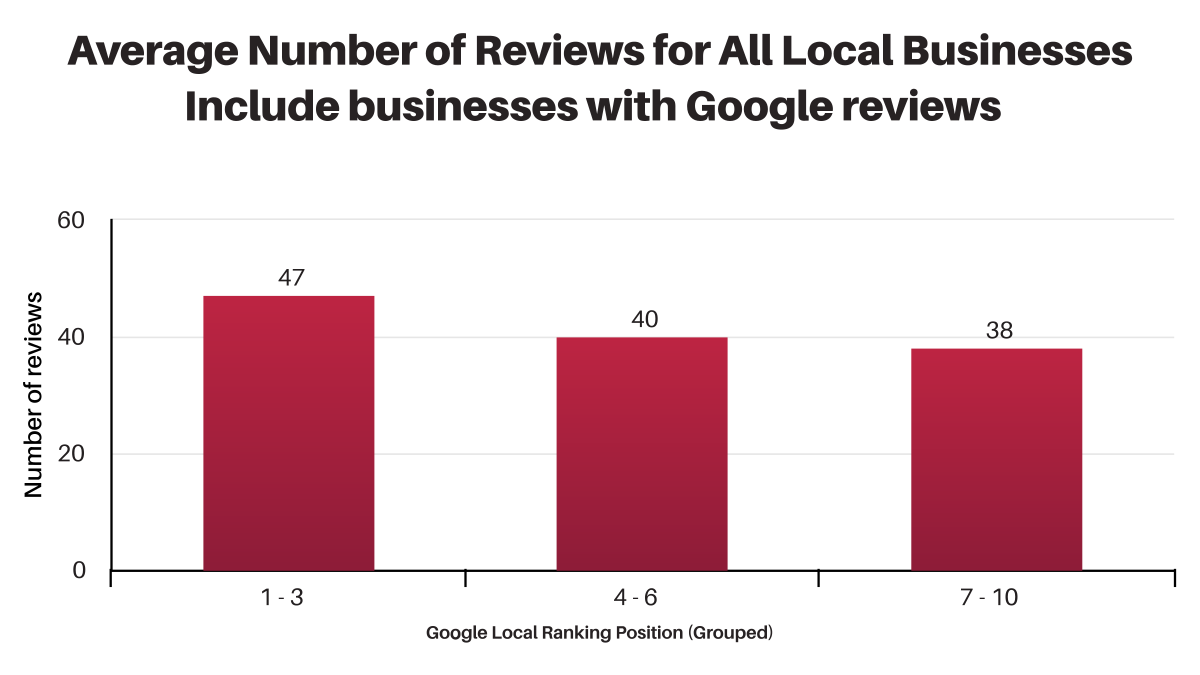 (Source: Google Reviews Study: How Many Reviews Do Local Businesses Need)
Unfortunately, reaching that number does not guarantee you a spot at the top.
According to the same study, the number of reviews of the top-ranking businesses differs by industry. Restaurants, for example, had an average of 220 Google reviews, but plumbers had only 31, and landscaping only had five.
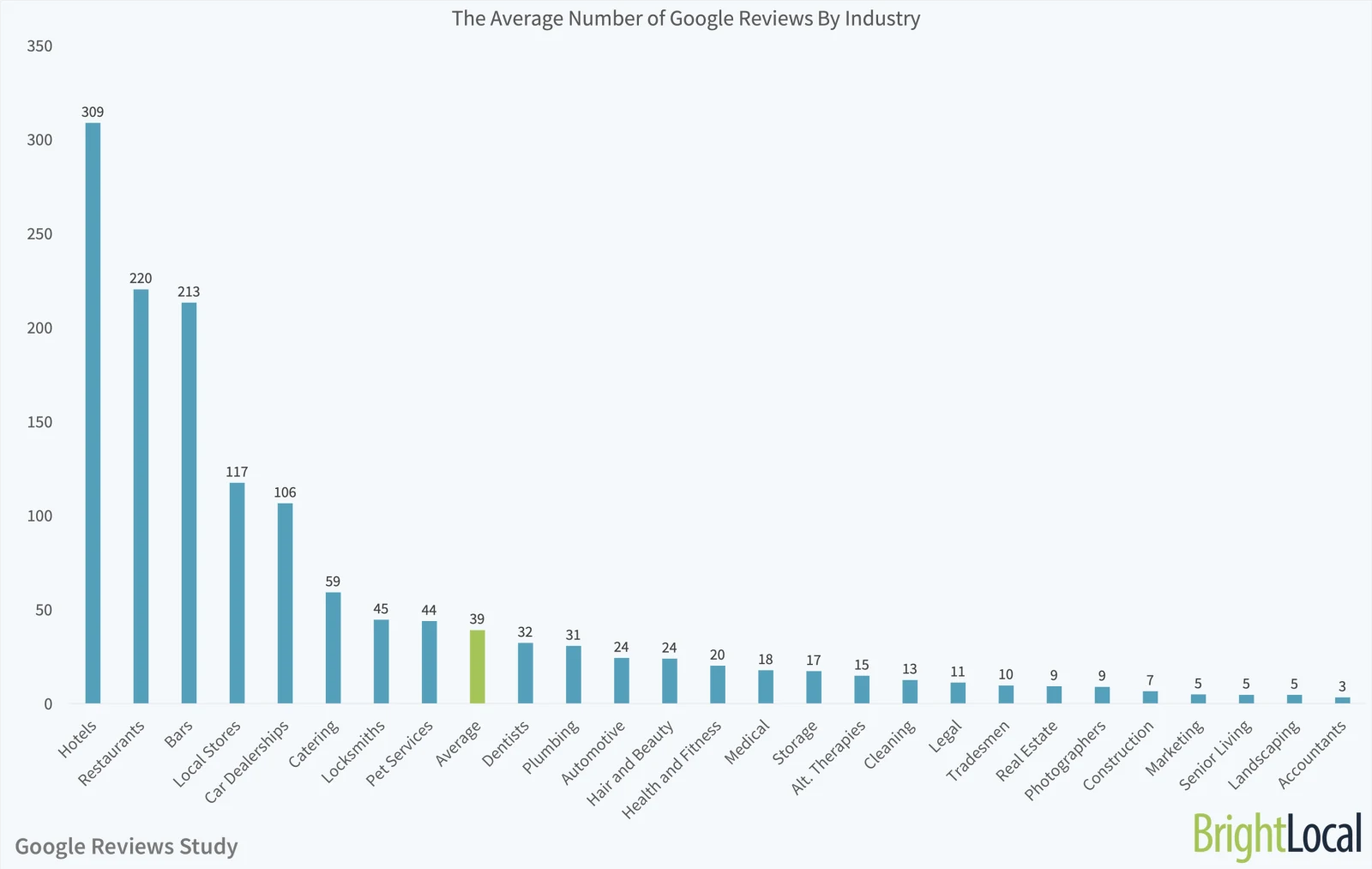
The above chart shows the average number of Google My Business [Google Business Profile] reviews for each industry, including businesses that do not have any reviews.
(Source: Google Reviews Study: How Many Reviews Do Local Businesses Need?)
As a result, there is no magic number that will ensure you the top spot. However, the more positive reviews you get, the more likely you are to beat your competitors.
Does it matter if you reply to reviews?
In a 2018 study published by the Harvard Business School, Replying to Customer Reviews Results in Better Ratings, they found that responding to reviews both positive or negative correlated with a higher overall star rating.
Google even says:
Respond to reviews that users leave about your business. When you reply to reviews, it shows that you value your customers and their feedback. High-quality, positive reviews from your customers can improve your business visibility and increase the likelihood of a shopper visiting your location.
(Source: How to improve your local ranking on Google)
So does it matter if you reply to reviews? Yes, it does!
Aside from improving your local rating, responding to reviews is a terrific way to engage your clients and earn their trust.
So, if a client provides feedback, express your gratitude. When you receive a negative review, apologize and demonstrate your dedication to resolving the issue.
Make Use of User-Generated Content on Review Websites
User-generated content (UGC) is essential in so many ways. For starters, UGC may help your SEO efforts, especially if your clients use important keywords and keyword phrases in their reviews.
Suppose you’re running a fly fishing guide service, and you have multiple delighted clients talking about “best fly fishing guides in <blank area>,” “best guide service,” “the most trout I have ever caught,” etc., on TripAdvisor or Google Business Profile. That’s good for your SEO as it provides positive and fresh content for search engines. Also, it helps to increase your brand visitability overall.
Second, UGC provides genuine social proof, which can increase your conversion rate. Consider bringing in third-party reviews such as Yelp or Trip Advisor into your landing pages to illustrate what other clients have to say about your products or services. Positive feedback will persuade skeptical visitors that your goods and services are genuine.
Client insights and keywords can also be found in user-generated content. Going through the reviews might uncover common words or phrases among your target market. You can then use these keywords and keyword phrases to help improve the content of your small business website.
Use Schema Markup
Schema Markup or structured data is a plugin or code that is added to your website to help search engines understand the contents on that page. After understanding the contents, search engines will display it to users in a more appealing and digestible way.
This helps make it easier for your potential clientele to find all the information they need on the SERPs. As a result, it raises the likelihood of attracting additional clients.
The local business schema markup is intended solely for local businesses. The codes display information such as a restaurant menu, your store's geographic location, business hours, aggregate reviews, and customer review snippets.
Gather Reviews From Local Authority Websites
Lastly, you will want to get reviews from the authoritative websites in your local area. An authoritative website will typically have a high domain authority (DA). The higher the DA generally, the more trusted they are by the search engines. As a result, getting your website mentioned and linked from these sites will significantly boost your rankings.
Use tools like aHrefs, Moz, or SEMRush, or your own experience to identify the top sites in your area.
These mentions and backlinks will lead potential clients to your website in addition to improving your local search rating.
Final Thoughts
Customer reviews are essential, especially for your business's SEO and bottom line. The more positive and diversified your reviews, the better your business's ranking and the more clients you'll attract.
As a result, encourage your consumers to submit positive reviews for your business. You can accomplish this by making it easy for people to review your store, i.e., making the procedure quick and straightforward. Of course, you should provide excellent services in order to receive positive reviews.
As the number of reviews grows, utilize the above guidelines to put them to good use.
Also, keep in mind that positive customer reviews will not immediately boost your local rankings. Like with any other SEO strategy, it takes time to produce results. But with a bit of patience, you will be able to rise to the top.
Written By: Chad J. Treadway | December 03, 2021
Chad is our Chief Smarketing Officer. He will help you survey your small business needs, educating you on your options before suggesting any solution. Chad is passionate about rural marketing in the United States and North Carolina. He also has several certifications through HubSpot to better assist you with your internet and inbound marketing.

Way back in 2012, when I started with Cube Creative Design, my business partner introduced me to podcasts. At the time, I resisted them because, frankly, I hated talk radio, and I thought that was all they were. People were going on and on about nothing! I, however, came around to the idea and started listing to a few here and there.
As time went by, I became more and more obsessed with them. I didn’t realize it at the time, but I was participating in “Automobile University.” Automobile University isn’t a university that you learn about automobiles but rather a phrase coined by Zig Ziglar. Zig Ziglar was an author, salesman, and motivational speaker who encouraged people to use their drive time to listen to “books on tape” or CDs. Podcasts were and still are a modern way of listening to relevant topics to me.
Now, like anything else, I have seen shows come and go, and as my position has changed over the years here at Cube Creative Design, so have my podcast choices. However, here is my current must listen to podcast list, along with links to the show themselves:
Written By: Chad J. Treadway | December 01, 2021
Chad is our Chief Smarketing Officer. He will help you survey your small business needs, educating you on your options before suggesting any solution. Chad is passionate about rural marketing in the United States and North Carolina. He also has several certifications through HubSpot to better assist you with your internet and inbound marketing.

Local search engine optimization (also called Local SEO) is like most other search engine optimization (SEO) techniques. It seeks to enhance the traffic to a site or a page on the Internet through targeted keyword usage in the search engines (Google, Bing, Duck Duck Go). However, the real key to local search engine optimization and the reason why it is one of the most effective strategies to marketing is that it can be done relatively easily.
Written By: Chad J. Treadway | November 29, 2021
Chad is our Chief Smarketing Officer. He will help you survey your small business needs, educating you on your options before suggesting any solution. Chad is passionate about rural marketing in the United States and North Carolina. He also has several certifications through HubSpot to better assist you with your internet and inbound marketing.
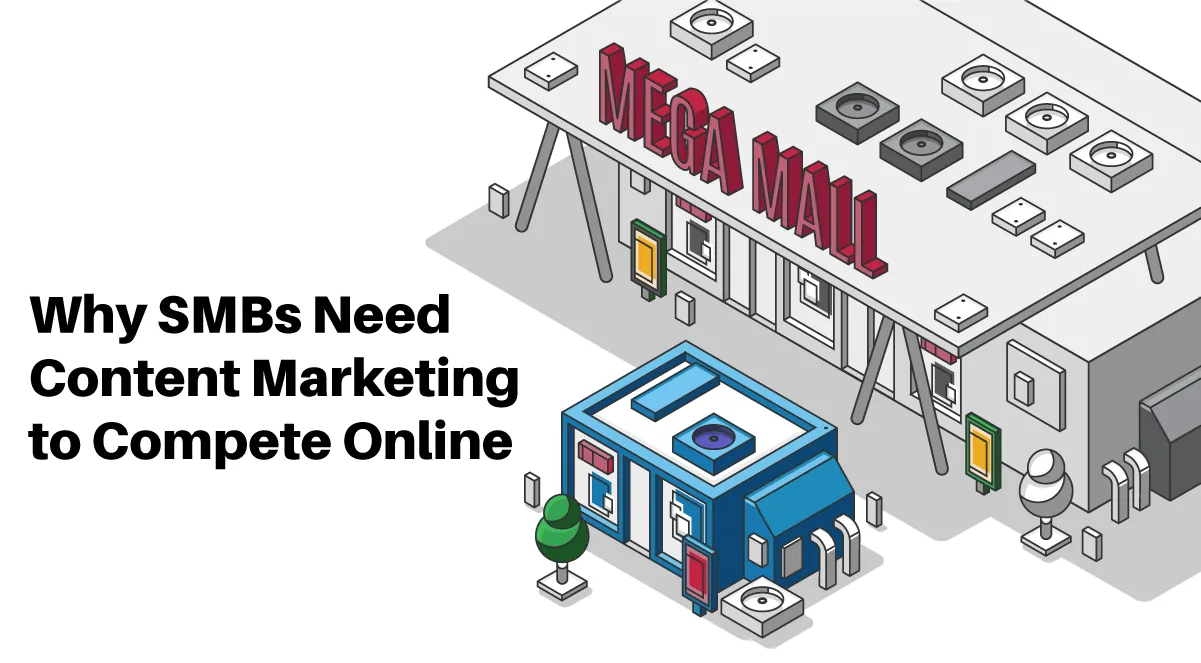
While there are numerous marketing tactics that your small business can experiment with, content marketing is one such strategy. Content marketing isn’t just cost-effective but highly effective in helping you get new clients.
You may be wondering what exactly it takes to create content that can be used in an internet search results area. Content marketing for small businesses can include articles, blogs, press releases, online videos, and podcasts. All of these formats can create content that is valuable and relevant to your clients and prospects. With search engine optimization (SEO), they are all places where your brand can be found and link back to your website and increase your search results.
If you are a small business owner, you should seriously consider content marketing for your business any time you want your marketing dollars to go further. It doesn’t matter if you are seeking new clients or those who have been loyal to your brand for years. SEO-focused content marketing is always a great way to reach your audience and your goals. Small business content marketing offers a unique opportunity to give your potential clients a value-added experience while giving your existing clients more information that will interest them as well.
Written By: Chad J. Treadway | November 17, 2021
Chad is our Chief Smarketing Officer. He will help you survey your small business needs, educating you on your options before suggesting any solution. Chad is passionate about rural marketing in the United States and North Carolina. He also has several certifications through HubSpot to better assist you with your internet and inbound marketing.
A well-executed Pay Per Click (PPC) campaign can generate more money for your small business than it costs. It enables you and fellow small and medium-sized companies to compete with the big boys for a fraction of the expense of a traditional advertising campaign in print, radio, or TV.
The problem that arises is getting your PPC ads to perform the way you need them to. If you own or are working for a small business, this may be where you are. You’re not alone. Truth be told, several PPC ads problems are pretty common. Just because other businesses struggle may not make you or your boss feel better, though, you are putting your hard-earned money out, and you should expect them to deliver even if it is something you’re struggling with.
Now the good news is that you don’t have to figure the solution out on your own. In this post, I am here to help you fix the three most common PPC ad problems.
Written By: Adam Bennett | November 15, 2021
Adam is the president and founder of Cube Creative Design and specializes in private school marketing. Since starting the business in 2005, he has created individual relationships with clients in Western North Carolina and across the United States. He places great value on the needs, expectations, and goals of the client.
If you don't have the money to invest in a comprehensive marketing plan, you're just getting started or just trying to make a place in the budget for another expense. Fortunately, you still have some FREE advertising choices.
Wayne Static once said, “Nothing in life is free, you always pay in the end.” That is true even with these free advertising ideas, as they will all require your time and attention. For small businesses, sometimes that might be easier than finding money in the budget for content marketing.
Written By: Chad J. Treadway | November 12, 2021
Chad is our Chief Smarketing Officer. He will help you survey your small business needs, educating you on your options before suggesting any solution. Chad is passionate about rural marketing in the United States and North Carolina. He also has several certifications through HubSpot to better assist you with your internet and inbound marketing.
Online reviews can be a potent marketing tool for your small business. Think about this: how often do you go online to see what others are saying about a service or product you're thinking of buying? Isn't it all the time? Your prospective clients are doing the same thing, so make sure you're winning the review game.
Want proof that asking for reviews and responding to and are smart moves?
- 89% of consumers will make an effort to read reviews before buying services or products. (Trustpilot).
- “79% of consumers say they trust online reviews as much as personal recommendations from friends or family. These days, word of mouth can come from outside a consumer's social circle, with an online review having a ripple outside of a happy (or unhappy!) customer's peers.” (Bright Local)
- Google and Amazon are by far the most popular channels people turn to for reviews. Google has 59%, and Amazon has 57%. (Bizrate Insights).
Reviews also provide a lot of value at little to no cost. You don't have to pay to leave or respond to a review, so it's free advertising for your small business. If you receive positive reviews and favorable feedback, these recommendations can and will impact future clients by instilling trust in your business before you even meet them!
Written By: Adam Bennett | November 10, 2021
Adam is the president and founder of Cube Creative Design and specializes in private school marketing. Since starting the business in 2005, he has created individual relationships with clients in Western North Carolina and across the United States. He places great value on the needs, expectations, and goals of the client.
Social media marketing is the general use of various social media websites and platforms to advertise a product or service, typically through social interactions. These social media platforms include LinkedIn, Pinterest, Facebook, Twitter, etc. This post will dive into its recent development and application, discuss its benefits for business and people, and analyze its potential as an upcoming marketing trend.
Written By: Hannah Kilpatrick | November 08, 2021
Hannah Kilpatrick Cube Creative DesignHannah Kilpatrick graduated from Western Carolina University in 2021 with a Bachelor of Science in Communication with a Minor in Marketing and a Concentration in Public Relations. She has been around social media since its creation. (Meaning, she was in the first grade when Facebook became available to the general public.) As our very own professional Gen-Z, Hannah is a whiz when it comes to social media creation and paid advertising.