 use Joomla\CMS\Uri\Uri;

Most private schools' market research strategy is a post-open-house gut check, a glance at the application numbers, and a prayer. The director of admissions tells the head of school the event "felt well-attended." Someone overheard a parent mention safety. Applications are down 10% from last year, and nobody can quite say why. That is not a strategy. That is anecdotal evidence dressed up in a meeting agenda, and for private schools competing in 2026, it is the most expensive habit on the calendar.
The schools winning enrollment battles right now do the unglamorous work of measuring things. They survey the families who left. They benchmark inquiry-to-tour rates against industry data. They know which touchpoint moves a family from "interested" to "applied." This is the discipline of market research, and it is what separates a school marketing director who keeps her job from one who explains, again, why this fall's class came in short. For private school marketing teams ready to trade impressions for intelligence, the methodology is well-defined, the benchmarks exist, and the tools are accessible. This post is the working tour.

Written By: Adam Bennett | June 04, 2026
Adam is the president and founder of Cube Creative Design and specializes in private school marketing. Since starting the business in 2005, he has created individual relationships with clients in Western North Carolina and across the United States. He places great value on the needs, expectations, and goals of the client.
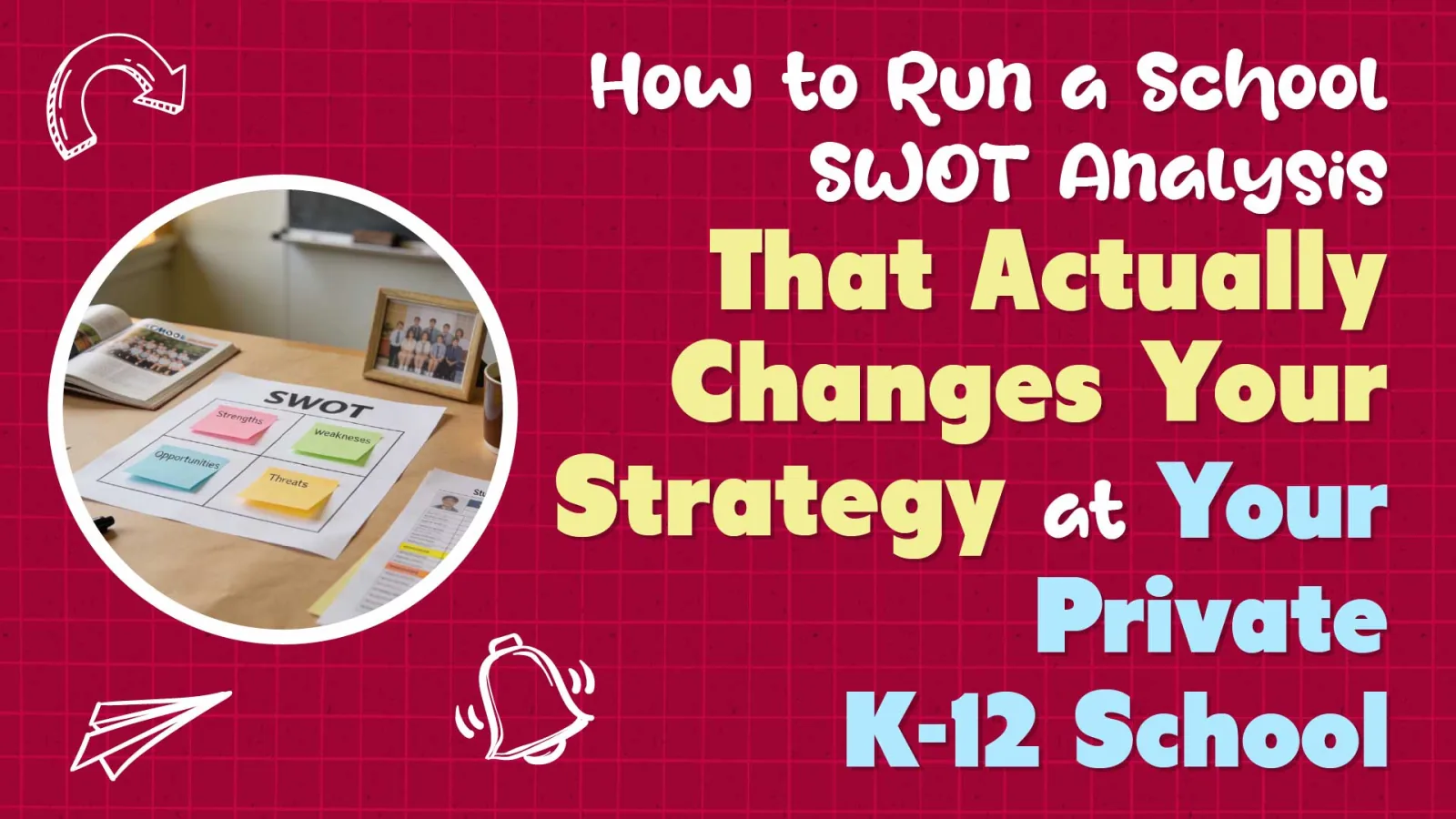
Your school probably has a strategic plan. It probably took months to produce, involved a consultant, and is currently sitting in a binder on a shelf in the development office. Nobody has opened it since the board approved it. That is not a strategy. That is a compliance document.
A real SWOT analysis is supposed to be the diagnostic that drives every enrollment and marketing decision you make for the next year. Most schools do not use it that way because most schools have never been shown how. They treat SWOT as a brainstorming exercise; it should be a stress test.
This guide is for the principal who is also the marketing director, the admissions counselor, and the person fixing the website at 10 PM. We work with private school leaders every week who tell us their last SWOT produced exactly zero decisions. Here is how to run one that does.
Written By: Adam Bennett | June 03, 2026
Adam is the president and founder of Cube Creative Design and specializes in private school marketing. Since starting the business in 2005, he has created individual relationships with clients in Western North Carolina and across the United States. He places great value on the needs, expectations, and goals of the client.
The pest control industry is having a moment. Demand is up, recurring revenue is healthy, and almost every truck on the road is busy. So why do so many independent owners in the 5-to-25 technician range feel like they're working harder every quarter and getting nowhere? Because the systems that worked at 3 trucks quietly stop working somewhere around 10, and nobody warns you when that line gets crossed. This post lays out the ten pest control business bottlenecks that hit almost every independent pest control company in this size range, in roughly the order they appear, with a way to self-diagnose and a sense of where the fix lives.
[Image suggestion: a pest control owner standing at a whiteboard with route stickers, looking at a tangled set of arrows; alt text: "Pest control owner mapping daily routes on a whiteboard at the dispatch ceiling."]

Written By: Chad J. Treadway | June 03, 2026
Chad is our Chief Smarketing Officer. He will help you survey your small business needs, educating you on your options before suggesting any solution. Chad is passionate about rural marketing in the United States and North Carolina. He also has several certifications through HubSpot to better assist you with your internet and inbound marketing.
Your pest control company just signed a lease on a second office 45 minutes away. The trucks are wrapped, the technicians are hired, and the phone line is set up. Then somebody on your team asks, "So do we just make another Google listing?" And suddenly you're staring at a verification screen, a video recording requirement, and a list of Google's guidelines that reads like tax code written by someone who genuinely enjoys tax code.
If you're a pest control company expanding into new markets, your Google Business Profile isn't a checkbox on your to-do list. It's the front door to every new territory you enter. Get it wrong, and you're invisible in the map pack. Get it really wrong, and Google suspends your listing, which can cascade to your other locations like termites spreading through a shared wall.
This guide covers everything a multi-location pest control operation needs to know about setting up, verifying, and managing Google Business Profiles across multiple markets in 2026. We're talking regulatory requirements, office setup strategy, video verification protocols, ranking signals, and the technology that holds it all together. Whether you're opening your second branch or managing your fifteenth, the playbook is the same. The stakes just get higher.
Written By: Chad J. Treadway | May 12, 2026
Chad is our Chief Smarketing Officer. He will help you survey your small business needs, educating you on your options before suggesting any solution. Chad is passionate about rural marketing in the United States and North Carolina. He also has several certifications through HubSpot to better assist you with your internet and inbound marketing.
You don't hire pest control technicians on gut feel; you shouldn't, anyway. And yet most independent operators in the $400K to $2M range pull the trigger because they're tired, their existing techs are running late, or a few customers complained last week. That's not a financial signal — that's a bad week.
The all-in cost of the next technician is north of $80,000 in year one, and a route that doesn't pull its weight can drag your margin sideways for 12 straight months. That's expensive guesswork. The good news for pest control operators sweating this decision: it's a math problem, not a feelings problem. Here are the numbers that tell you when to hire, when to wait, and what to fix first.
Written By: Adam Bennett | June 02, 2026
Adam is the president and founder of Cube Creative Design and specializes in private school marketing. Since starting the business in 2005, he has created individual relationships with clients in Western North Carolina and across the United States. He places great value on the needs, expectations, and goals of the client.

If you run a home service company, you already know the pattern. Summer is chaos. Fall starts to cool off. And then somewhere around late October, you look at the schedule and wonder where everybody went. It is like your phone forgot how to ring.
Every home service business deals with some version of this. HVAC companies see it in spring and fall. Roofers feel it in winter. Landscapers watch it happen as soon as the first frost hits. The slow season is not a surprise. But for some reason, most business owners wait until they are staring at an empty calendar before they start doing something about it.
That is the wrong approach. The time to build your slow season marketing strategy is right now, while you are still busy. Think of it like changing the oil in your truck. You do not wait for the engine to seize. You do it on schedule so everything keeps running.
Written By: Chad J. Treadway | June 02, 2026
Chad is our Chief Smarketing Officer. He will help you survey your small business needs, educating you on your options before suggesting any solution. Chad is passionate about rural marketing in the United States and North Carolina. He also has several certifications through HubSpot to better assist you with your internet and inbound marketing.

Quick test. Pull up your school's marketing plan template and read the first page. If what you find is a Google Calendar, a viewbook refresh, and a vague intention to "do more on Instagram this year," you do not have a plan. You have a wish list with deadlines.
A real annual marketing plan is a strategic document. It quantifies the enrollment funnel, allocates budget by channel against measurable outcomes, accounts for the demographic shift already pinching K-12 pipelines, and dedicates explicit attention to retention rather than treating it as an afterthought. Most heads of school cannot produce that document on demand, which is exactly why most schools spend their marketing budgets reacting instead of planning. This piece walks through the framework that we build with private and independent schools every year. By the end, you will have the template you need to either build one in-house or evaluate whether the agency you already hired is delivering one.
Written By: Adam Bennett | June 02, 2026
Adam is the president and founder of Cube Creative Design and specializes in private school marketing. Since starting the business in 2005, he has created individual relationships with clients in Western North Carolina and across the United States. He places great value on the needs, expectations, and goals of the client.

Between 2020 and 2023, a lot of private schools grew without much of a plan. Public school families were leaving in waves, and any school with an open seat and a working website caught the wind. That tailwind is gone. The Cato Institute's 2024 Private School Enrollment Survey found that 32% of private schools reported enrollment declines in 2024-2025, with 48% pointing to family financial constraints as the leading cause (Cato Institute, 2024). And a demographic dip projected to run from 2025 through 2037 is about to put structural pressure on every school that hasn't documented a real strategy.
If you're the marketing director, admissions director, or head of school staring at a flat enrollment chart and wondering what to do about it, this guide is for you. It walks through the nine layers of a working private school marketing plan, from situational analysis through measurement, with the actual benchmarks and research that should inform each step. The team at Cube Creative Design has spent two decades helping private and independent schools translate this kind of plan into enrolled families, and we wrote this guide to be the document you bookmark, hand to your board, and come back to every spring when you sit down to build next year's plan.
Fair warning: this is a long one. You can skim the section headings and jump to whatever you're working on this week, but the steps build on each other. Skipping situational analysis to get to "social media tactics" is how schools end up with marketing plans that look great on a slide deck and produce nothing in the funnel.
Written By: Adam Bennett | June 01, 2026
Adam is the president and founder of Cube Creative Design and specializes in private school marketing. Since starting the business in 2005, he has created individual relationships with clients in Western North Carolina and across the United States. He places great value on the needs, expectations, and goals of the client.
Most pest control owners think they have a sales problem when they hit the eight-technician wall. They don't. They have a systems problem, and the worst part is that the systems holding them back are the same ones that built the first million dollars.
The independent owner who climbs from a one-truck startup to an eight-tech operation usually does it on a specific formula: the owner runs the hardest accounts, knows every customer by first name, dispatches the next day's routes in their head, and closes most of the sales personally. That formula works well, right up until it doesn't. It has an expiration date, and it sits squarely between technician seven and technician nine.
This is the 8-tech wall, and it shows up with almost mathematical predictability. The systems that supported your first $1 million in revenue are the exact things preventing the next $1.5 million. You can't add your way through it. You have to rebuild the engine while the truck is still on the road.
This post is for pest control business owners sitting between six and twenty technicians who've felt the wall and want a real plan to get through it. Not a pep talk. A blueprint with the financial triggers, operational choke points, hiring milestones, software upgrades, and marketing budget shifts you actually need to break the plateau without blowing up your margins on the way through.
The thesis is short: scaling from 6 to 20 techs is a complete business restructuring. Financial architecture, operations, management layer, and marketing mix all have to evolve in sequence. You can't just add routes. You have to build the machine that runs the routes.
Written By: Chad J. Treadway | June 01, 2026
Chad is our Chief Smarketing Officer. He will help you survey your small business needs, educating you on your options before suggesting any solution. Chad is passionate about rural marketing in the United States and North Carolina. He also has several certifications through HubSpot to better assist you with your internet and inbound marketing.

These days, there’s a lot of competition in the digital space, so small businesses can’t rely solely on traditional forms of advertising (like newspaper ads) to gain customers. More than ever before, people are searching for products and services online before deciding whether or not to buy them. The vast majority of consumers will investigate several options (including local services), compare prices, and read reviews about a product before they make their final purchase decision.
If you want your small business to attract new customers, having a solid online presence is critical to establishing yourself as a credible and accessible resource for potential buyers throughout their entire buying journey.
Many small and local businesses believe that creating an online presence can only be accomplished by spending a large amount of money or hiring a professional marketing team, but that is not true.
Any business can effectively compete to earn its share of the buyer's business by developing and implementing the right strategy based on three key principles: consistent use of the same message across all platforms; providing customers with an excellent user experience; and developing a strong relationship with each buyer. By doing so, you will generate qualified leads, improve brand awareness, and create long-term growth for your small business through digital marketing.
Companies that focus on building their digital visibility typically experience increased customer engagement through higher conversion rates over the long term. The way your business appears in the digital world (including your website, search engines, social media, or customer reviews) is a significant factor affecting how people perceive your small business.
Thus, creating a strong foundation within your digital ecosystem is not about being everywhere digitally, but rather, it’s about creating compelling experiences for your buyers that result in developing trust with them and increasing their likelihood of choosing to do business with your brand.
A retired homeowner walks into her sunroom on a Tuesday morning and discovers a raccoon staring back at her through the screen door. The raccoon has been living in her attic for two weeks. There are scratches on the door frame. The drywall in the master closet is starting to stain. By Wednesday, she has called five companies. The one that picks up first, sounds professional, and quotes a clear number gets the trapping job, the exclusion work, and the attic remediation. Total ticket: well into four figures from one customer.
Wildlife control is the high-ticket cousin of general pest work, and most pest control companies are either ignoring it or treating it as an afterthought. The math does not favor that approach. Wildlife jobs commonly run 5 to 20 times the average ticket of a residential pest call. The customer is more emotionally invested. The competitive set is smaller. The lifetime value, when you bundle in restoration and prevention work, is substantial.
This guide walks through the market opportunity, the pricing model, the consumer psychology that drives wildlife calls, the digital marketing tactics that capture them, the operational lift required to add wildlife to your service mix, and the regulatory requirements you cannot ignore. By the end, you should have a clear sense of whether wildlife services belong in your business and, if they do, how to market them to win.
Written By: Chad J. Treadway | May 29, 2026
Chad is our Chief Smarketing Officer. He will help you survey your small business needs, educating you on your options before suggesting any solution. Chad is passionate about rural marketing in the United States and North Carolina. He also has several certifications through HubSpot to better assist you with your internet and inbound marketing.
The first question pest control owners ask when considering wildlife services is usually about the equipment or the training. The second question should be about licensing, but it often isn't until someone gets cited. Wildlife control in the United States is regulated at the state level, with federal overlays for specific species, and the licensing requirements don't always match what pest control owners expect coming from structural pest work.
This guide is an overview of how wildlife licensing works for pest control companies considering expansion into wildlife services. I'll cover the typical state-level license structure, federal requirements, insurance implications, continuing education, penalties for unlicensed work, and how to build the licensing timeline into your expansion plan. This is not legal advice, and state regulations change; always verify current requirements with your state wildlife agency or pest management association before operating.
Written By: Adam Bennett | May 29, 2026
Adam is the president and founder of Cube Creative Design and specializes in private school marketing. Since starting the business in 2005, he has created individual relationships with clients in Western North Carolina and across the United States. He places great value on the needs, expectations, and goals of the client.