
There are 68,000 professional business data updates occurring every single hour across the global economy. This constant state of flux explains why 77% of small businesses now utilize specialized sales intelligence tools to find accurate prospecting information.
Picking a platform shapes how an SMB builds its pipeline and utilizes its limited sales budget. The right vendor helps teams work faster with verified data, while the wrong one leads to wasted outreach and missed opportunities.
Every home service business hits a rough patch. Maybe it's a seasonal slowdown where the phone goes quiet for weeks. Maybe it's an economic downturn that makes homeowners put off that new HVAC system or roof replacement. Or maybe it's just one of those stretches where everything that could go wrong does.
Here's what separates the home service companies that make it through from the ones that don't: it's not luck. It's preparation, smart decisions, and a willingness to adjust before things get desperate.
If you're running an HVAC, plumbing, roofing, or electrical company with a handful of employees and you're worried about what happens when business slows down, this post is for you. These are home service business tough times strategies that actually work, from owners who've been there.

Written By: Chad J. Treadway | March 12, 2026
Chad is our Chief Smarketing Officer. He will help you survey your small business needs, educating you on your options before suggesting any solution. Chad is passionate about rural marketing in the United States and North Carolina. He also has several certifications through HubSpot to better assist you with your internet and inbound marketing.

Not long ago, a private school’s reputation traveled mostly by word of mouth, discussed in country clubs, shared in church basements, and reinforced through alumni networks. Tradition and prestige did the heavy lifting, while the school’s thick, glossy brochure filled in the remaining details for prospective parents.
That world has changed. Today’s digital parents research schools the same way they research hotels or restaurants: online. Reviews, social media conversations, and education forums all shape first impressions.
And the stakes are high. According to the National Center for Education Statistics (NCES), roughly 29,730 K–12 private schools operated across the U.S. during the 2021–22 school year, giving families thousands of options to consider.
In this environment, reputation doesn’t begin at the front gate. It begins online. Tradition and prestige still matter, but they now work best when supported by a strong digital presence. For privately funded institutions competing for enrollment, a thoughtful online reputation strategy has become essential for standing out and earning parents’ trust.
In this article, we’ll explore several practical online reputation strategies private schools can use to strengthen credibility and attract prospective families.

Finding the right marketing agency in Wisconsin has never been more important or more complicated.
The marketing landscape has shifted dramatically over the past two years. AI-powered search engines like ChatGPT, Perplexity, and Google's Gemini have fundamentally changed how audiences find businesses. Traditional SEO is no longer enough. The agencies that understand this shift and have built their services around it are the ones delivering results in 2026. The ones that have not are still optimising for a world that no longer fully exists.
This list focuses on Wisconsin agencies that are actually equipped for where marketing is heading, not just where it has been. Whether you are a local business in Madison, a regional brand in Milwaukee, or a growing company anywhere across the state, these are the agencies worth your time.
If you asked your marketing director how your school's website is performing, they'd probably give you a number. Maybe traffic is up 12%. Maybe you got 500 more visitors this month than last. Those numbers sound encouraging, but they don't answer the question that actually matters: is the website converting visitors into families who inquire, apply, and enroll?
That's what benchmarks are for. Not vanity metrics that sound good in a board presentation, but performance standards that tell you whether your website is doing its job compared to schools like yours.
For independent school leaders who need to evaluate marketing performance without getting into tactical weeds, these are the benchmarks that matter, what they mean, and where your school should fall.

Written By: Hannah Kilpatrick | March 11, 2026
Hannah Kilpatrick Cube Creative DesignHannah Kilpatrick graduated from Western Carolina University in 2021 with a Bachelor of Science in Communication with a Minor in Marketing and a Concentration in Public Relations. She has been around social media since its creation. (Meaning, she was in the first grade when Facebook became available to the general public.) As our very own professional Gen-Z, Hannah is a whiz when it comes to social media creation and paid advertising.
A solo plumber in North Carolina spent $300 a month on a generic digital marketing package from a national agency. The package promised "proven lead generation strategies." Six months later, he'd received 12 low-quality inquiries from outside his 40-mile service area. He canceled the contract, frustrated and out $1,800. His problem wasn't that he needed more marketing—it was that the marketing was built for every business instead of for home service companies.
This scenario repeats itself thousands of times annually. Home service business owners invest in marketing advice and tactics designed for e-commerce stores, SaaS companies, or consumer product brands. They wonder why conversion rates are terrible and why they're throwing money at strategies that work for someone else's industry—just not theirs.
The issue is fundamental: home service marketing operates under completely different rules than general business marketing. Your customers aren't shopping online for a commodity product. They're looking for a trusted local expert who can solve an urgent problem—a leaky pipe, a failing AC system, or a roof ready to fail. They want to see reviews, confirm you serve their area, and pick up the phone. Generic marketing misses every one of these triggers.
This post explains why cookie-cutter marketing tactics fail for plumbing, HVAC, roofing, electrical, landscaping, and other home service trades—and what works instead.
Written By: Chad J. Treadway | March 10, 2026
Chad is our Chief Smarketing Officer. He will help you survey your small business needs, educating you on your options before suggesting any solution. Chad is passionate about rural marketing in the United States and North Carolina. He also has several certifications through HubSpot to better assist you with your internet and inbound marketing.
If you've built your pest control business primarily on residential work, commercial accounts probably feel like a different sport altogether. They are. The shift from homeowners to facility managers, procurement professionals, and building owners requires rethinking almost everything about your marketing.
Here's the opportunity: commercial pest control is the fastest-growing segment in our industry. The commercial market generated 9.0% growth in 2024, according to the National Pest Management Association, compared to the broader industry's 7.9% expansion. These contracts run for 12 months or longer with renewal rates above 80%. A mid-size pest control company that lands even three solid commercial accounts can transform its revenue stability for years.
But commercial marketing isn't about bigger residential ads. It's about position, expertise, documentation, and understanding how businesses actually buy services. This guide walks you through the complete commercial pest control marketing system for a mid-size company looking to build this segment from scratch or scale what you've already started.
Written By: Chad J. Treadway | March 09, 2026
Chad is our Chief Smarketing Officer. He will help you survey your small business needs, educating you on your options before suggesting any solution. Chad is passionate about rural marketing in the United States and North Carolina. He also has several certifications through HubSpot to better assist you with your internet and inbound marketing.

Is tax season costing your small business money? When you’re a small business owner, you have to wear a lot of hats, and that can translate to stress when tax season rolls around. From reviewing expenses to staying organized, you’ll need to be diligent to avoid costly errors or missed opportunities for deductions.
Getting a head start on tax planning can ease your stress levels and help position your business for greater success. Read on to learn more about why early tax planning is smart for small business owners.

Where do skilled tradespeople go when career inspiration strikes?
You got it: Google.
Both aspiring and experienced tradespeople begin their job and training searches with a simple inquiry. Ranking for this inquiry, also known as a keyword, can make all the difference between you and your competition in recruiting a quality lead.
Speaking of competition. If they're already optimizing their online strategy with career page SEO, Google Jobs visibility, geofencing, partnerships, testimonials, apprenticeships, and community boards, it's time to roll up your sleeves and get to work.
Let's take a deep dive into these 7 strategies for successful trades recruiting online.
If you run a pest control company, you've likely noticed that winning commercial accounts feels different from residential work. The buying process is longer, the stakes are higher, and the decision-makers ask harder questions. That's because facility managers aren't just buying extermination — they're buying compliance, reputation protection, and risk management.
This post flips the script. Instead of writing for facility managers directly, we're writing for pest control companies so they understand exactly what their commercial prospects are evaluating. When you know the 10 questions facility managers are asking, you can position your company to answer them before they're even asked.
The commercial pest control segment accounts for nearly 40% of the global pest control market. According to market research, North America alone represented over 40% of global pest control revenue, generating approximately $8.6 billion in 2024. Yet most independent pest control companies treat commercial accounts as an afterthought. The operators who win these contracts — and keep them — are the ones who understand that facility managers operate under different pressures, regulatory requirements, and decision criteria than homeowners.
Let's walk through the 10 questions your commercial prospects are asking.

Written By: Adam Bennett | March 09, 2026
Adam is the president and founder of Cube Creative Design and specializes in private school marketing. Since starting the business in 2005, he has created individual relationships with clients in Western North Carolina and across the United States. He places great value on the needs, expectations, and goals of the client.
You've got a solid residential route. Trucks are rolling. Techs are busy. But every month, it's the same grind, chasing one-off treatments, dealing with seasonal dips, and watching revenue flatline the second winter hits. You know commercial work is the next move. You've heard the pitch: "Get into multi-unit properties and watch your recurring revenue take off." So you start cold-calling property managers, dropping off business cards at leasing offices, maybe even undercutting the competition on price just to get a foot in the door.
And nothing happens. Or worse—you land a contract, realize the margins are razor-thin, and wonder why you bothered.
Here's the thing most pest control companies miss: property managers aren't shopping for the cheapest spray jockey. They're buried under vendor relationships—HVAC contractors, plumbers, electricians, carpet cleaners—all fighting for attention and budget. What they actually need is a partner who understands that pest complaints don't just kill comfort; they kill lease renewals. Across the 43.9 million rental units in the United States, pest-related tenant complaints are one of the fastest paths to costly turnover and bad reviews. The pest control company that frames itself as the solution to that problem, not just "bug spraying," is the one that wins the contract and keeps it.
This guide breaks down exactly how to make that shift. We'll walk through how to identify and target the right property managers, craft messaging that speaks their language, build a marketing system that generates inbound commercial leads, and position your company as the vendor they can't afford to replace. Whether you're just dipping a toe into commercial work or you're ready to scale an entire division, this is the playbook.
At Cube Creative Design, we help pest control companies reach the commercial prospects they need to grow. For a lot of our clients, cracking into property management partnerships has been the difference between staying flat and building a seven-figure operation.
Written By: Chad J. Treadway | March 09, 2026
Chad is our Chief Smarketing Officer. He will help you survey your small business needs, educating you on your options before suggesting any solution. Chad is passionate about rural marketing in the United States and North Carolina. He also has several certifications through HubSpot to better assist you with your internet and inbound marketing.
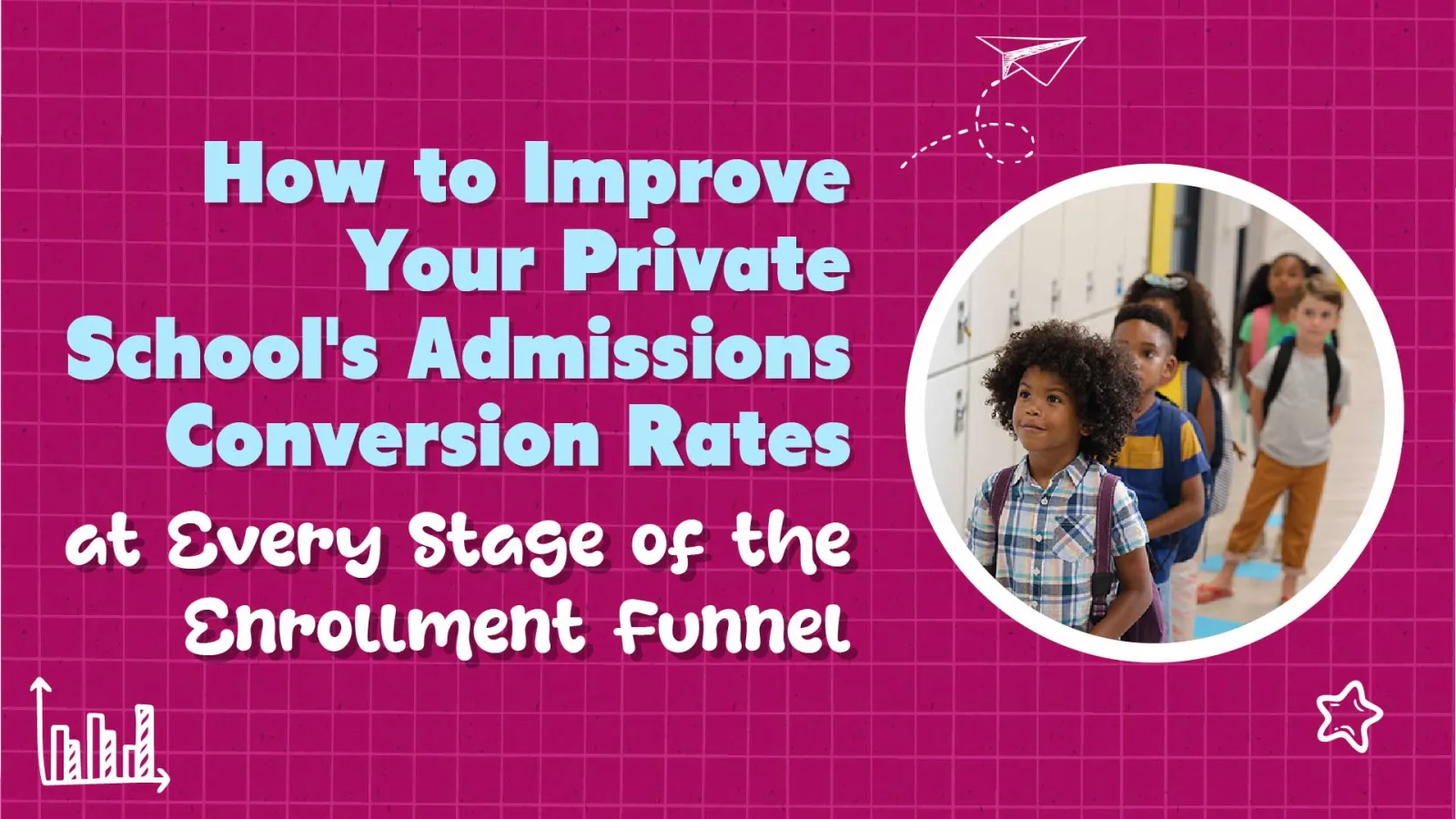
If your school generated 500 inquiries this year and enrolled 40 new students, your full-funnel conversion rate is 8%. That's above the 3-5% average, so it sounds fine. But here's what the aggregate number hides: somewhere between inquiry and enrollment, 460 families decided your school wasn't for them. Some were never a fit. Some were always going to choose the school closer to home. But some, maybe dozens, were persuadable families who slipped through the cracks because the follow-up was too slow, the application was too complicated, or the campus visit didn't answer the questions they actually had.
Those are the families that conversion rate optimization is designed to recover.
For school admissions teams operating in the March-April application window, this isn't theoretical. Every percentage point you recover at any funnel stage translates directly into enrolled students and tuition revenue. This post breaks down each stage of the admissions funnel, provides conversion benchmarks, and identifies the specific fixes that produce the biggest gains.
Written By: Adam Bennett | March 09, 2026
Adam is the president and founder of Cube Creative Design and specializes in private school marketing. Since starting the business in 2005, he has created individual relationships with clients in Western North Carolina and across the United States. He places great value on the needs, expectations, and goals of the client.