
Texas is about to experience one of the most significant shifts in public education funding in its history. Starting with the 2026-2027 school admission year, families across the Lone Star State will have access to publicly funded Education Savings Accounts that can be used toward private school tuition and a wide range of other approved educational expenses.
Signed into law as Senate Bill 2 during the 89th Texas Legislative session, this $1 billion initiative is officially known as the Texas Education Freedom Accounts, or TEFA. For parents who have long wanted more control over how and where their children are educated, this program represents a turning point that could fundamentally change the educational landscape in Texas.
Spring is the gauntlet for pest control. You've got six weeks to capture half your annual revenue, and every missed call is a customer going to someone else. But here's the frustrating part: you probably have no idea which marketing dollars actually generated that call.
You're running Google Ads. You're posting on social. You've got a website. Yet when the phone rings, you answer it as if your customers found you through magic. That's not strategy — that's luck. And luck doesn't scale.
This is where call tracking for pest control companies becomes non-negotiable. Not because it's trendy. Because it's the only way to connect a $50 ad click to a $2,500 termite contract. And if you're not tracking that link, you're leaving money on the table every single day.

Written By: Adam Bennett | March 06, 2026
Adam is the president and founder of Cube Creative Design and specializes in private school marketing. Since starting the business in 2005, he has created individual relationships with clients in Western North Carolina and across the United States. He places great value on the needs, expectations, and goals of the client.
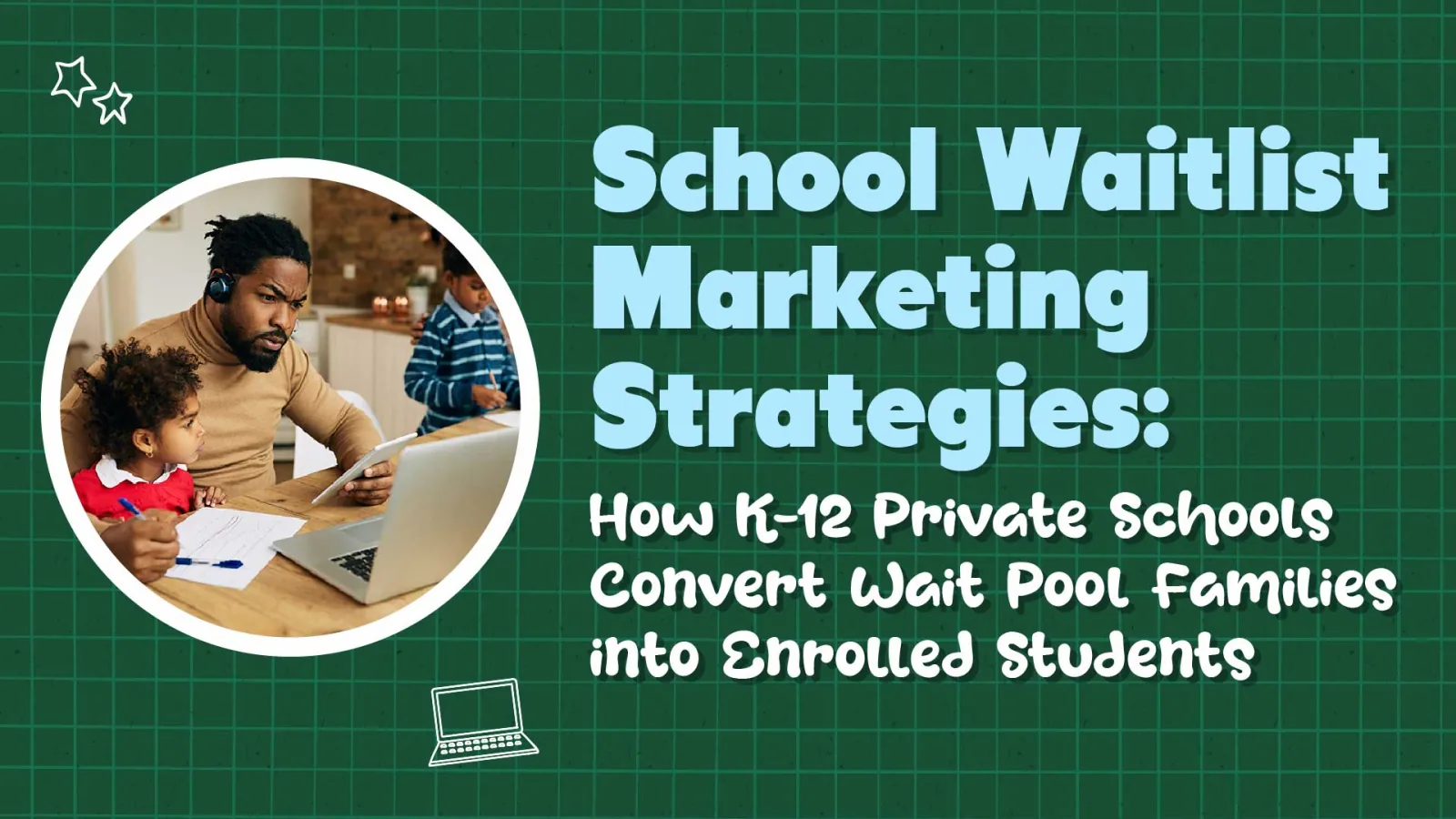
Your admissions team just sent out acceptance letters, and the yield numbers are starting to come in. Some families were accepted immediately. Others asked for more time. And a group of qualified, mission-appropriate families landed in your wait pool because you didn't have enough seats for everyone who deserved one.
Here's the part that most private school admissions teams get wrong: they treat the wait pool like a filing cabinet. Families go in, and unless a spot opens, nothing happens. No communication. No engagement. No strategy. Then, when three families decline their acceptance offers in May, the admissions office scrambles to fill seats from a wait pool full of families who've already enrolled somewhere else.
That's not a wait pool problem. That's a marketing problem. And it's solvable.
NAIS enrollment data shows that yield rates at independent schools hover around 70%, which means roughly 3 out of every 10 accepted families will not enroll. For a school that sent 80 acceptance letters to fill 55 seats, that math means 24 families will say no. Some of those seats will go unfilled unless your wait pool strategy is ready.
Written By: Adam Bennett | March 05, 2026
Adam is the president and founder of Cube Creative Design and specializes in private school marketing. Since starting the business in 2005, he has created individual relationships with clients in Western North Carolina and across the United States. He places great value on the needs, expectations, and goals of the client.

Your website gets 500 visits from a Google Ads campaign targeting "termite inspection near me." Two weeks later, your analytics show: 487 bounces. Nine form submissions. Four booked jobs. That gap between traffic and conversions? That's your landing page problem.
Spring is when pest control search intent reaches its peak. Homeowners panic about termite swarms, carpenter ant invasions, and mosquito breeding programs. They search desperately for solutions. And they're willing to book services immediately when they find a provider they trust. The research document that informed this post revealed something stark: the average consumer will call only 1.3 businesses before making a decision. That means your landing page is often the deciding factor — not your technicians, not your reviews, not your brochure. It's whether your page answers the question they asked in under three seconds and makes them confident enough to fill out your form.
For companies like yours that are growing regionally and tracking marketing ROI carefully, landing page quality isn't a vanity metric. It's the difference between a 2% conversion rate on paid traffic and a 4% conversion rate. On a $100,000 spring ad budget, that's the difference between 100 qualified leads and 200 qualified leads.
If you're evaluating marketing strategies for pest control companies, this guide walks through the proven CRO principles that work specifically for spring campaigns.

Written By: Chad J. Treadway | March 05, 2026
Chad is our Chief Smarketing Officer. He will help you survey your small business needs, educating you on your options before suggesting any solution. Chad is passionate about rural marketing in the United States and North Carolina. He also has several certifications through HubSpot to better assist you with your internet and inbound marketing.

You wouldn't show up to a service call in a beat-up van with no logo, a cracked windshield, and a handwritten phone number on the door. But that's basically what a lot of home service businesses are doing online. Their website is the digital equivalent of that van, and homeowners are making a judgment call before they ever pick up the phone.
Here's the thing: your professional website home service business depends on isn't just a digital business card. It's the front door to your company. It's the first impression, the trust builder, and often the deciding factor between you and the other plumber, HVAC tech, or roofer who shows up in the same Google search. And in 2026, the bar for what "professional" looks like has gone up.
If you're running a small service area business with a handful of employees and a website you set up on a Saturday afternoon three years ago, this post is for you. Let's talk about what a professional website actually looks like for an SAB, why it matters more than ever, and what you need to have on yours to turn visitors into booked jobs.
Written By: Chad J. Treadway | March 05, 2026
Chad is our Chief Smarketing Officer. He will help you survey your small business needs, educating you on your options before suggesting any solution. Chad is passionate about rural marketing in the United States and North Carolina. He also has several certifications through HubSpot to better assist you with your internet and inbound marketing.

Here's something that school leaders at smaller schools already know but rarely say out loud: you can't afford empty seats. When tuition runs $3,000-$5,000 per student, and your marketing budget is $5,000-$15,000 for the entire year, every unfilled seat isn't just a number on a spreadsheet. It's a teacher you can't hire, a program you can't run, or a repair you can't make.
And yet, most school admissions teams treat the late application window (March through May) like it's already over. Applications are closed. The website still shows last January's deadline. The admissions director has moved on to re-enrollment paperwork.
Meanwhile, families who would have applied are searching "private schools near me" and finding a school down the road that still has its doors open. According to NAIS research, 40% of private schools grew enrollment in 2024-25 while 32% declined. That gap isn't random. It's the difference between schools that kept recruiting and schools that stopped.
Late enrollment marketing isn't desperate. It's strategic. Here's how to do it on a budget that matches your reality.
Written By: Adam Bennett | March 04, 2026
Adam is the president and founder of Cube Creative Design and specializes in private school marketing. Since starting the business in 2005, he has created individual relationships with clients in Western North Carolina and across the United States. He places great value on the needs, expectations, and goals of the client.
Let's face it: your customers don't sit at a desk and Google "pest control near me." They discover termites in a crawlspace at 9 PM, grab their phone, and scroll through results while standing in their attic. That moment — when panic meets urgency — is when pest control gets won or lost. And it's almost always on a 6-inch screen.
If your website isn't optimized for that frantic mobile search, you're not just missing a few leads. You're actively handing your revenue to a competitor with a faster-loading site and a clickable phone button. This isn't theoretical. Pest control companies that ignore mobile optimization lose approximately $47,000 per year in potential revenue — based on average job value and missed lead volume.
The numbers back this up, and they're shocking. Here's what you need to know to keep those leads coming in.
Written By: Adam Bennett | March 04, 2026
Adam is the president and founder of Cube Creative Design and specializes in private school marketing. Since starting the business in 2005, he has created individual relationships with clients in Western North Carolina and across the United States. He places great value on the needs, expectations, and goals of the client.
If you run a pest control company and your phone isn't ringing like it used to, the problem might not be your service. It might be that your customers can't find you. Local search has always been the front door to your business, but in 2026, someone moved the door, changed the lock, and added an AI bouncer. The way homeowners find and choose pest control companies has shifted in ways that affect every operator, from a 3-truck startup to a 50-technician regional player. These local seo statistics tell the story of where the industry stands right now and where your marketing needs to go next. If you're starting from scratch or want to understand the fundamentals, our local SEO guide covers the core concepts that drive success.
Written By: Chad J. Treadway | March 04, 2026
Chad is our Chief Smarketing Officer. He will help you survey your small business needs, educating you on your options before suggesting any solution. Chad is passionate about rural marketing in the United States and North Carolina. He also has several certifications through HubSpot to better assist you with your internet and inbound marketing.
Wasp and bee removal calls are not like routine pest control. They're emergencies. A homeowner spots a nest near their deck, panic sets in, and suddenly they're frantically searching "wasp nest removal near me" on their phone. If your pest control marketing isn't visible at that exact moment, a competitor will grab the call instead.
The challenge isn't making the sale once someone calls. The challenge is being found when they're searching. And the window is short. Unlike general pest control, which homeowners plan for months in advance, wasp and bee removal is high-intent, time-sensitive, and seasonal. Your marketing strategy must account for this reality.
This post walks through how to market wasp and bee removal services effectively, when to increase your marketing investment, and how to convert seasonal spikes into recurring revenue. Whether you're running a growing operation or looking to fill your route during peak season, the tactics here will help you capture the calls you're missing.
Written By: Chad J. Treadway | March 03, 2026
Chad is our Chief Smarketing Officer. He will help you survey your small business needs, educating you on your options before suggesting any solution. Chad is passionate about rural marketing in the United States and North Carolina. He also has several certifications through HubSpot to better assist you with your internet and inbound marketing.

Six months ago, Mike opened his plumbing company from his garage with a truck he'd financed and a website he built himself on a free template. He had zero customers and a $200/month budget for marketing—if he could even spare that from cash flow. He couldn't afford a marketing agency. He couldn't afford expensive Facebook ads or Google Local Services Ads. He needed a way to get customers cheap, and he needed it fast.
Mike's situation is the reality for most new home service company owners. You're bootstrapping. You're working 60-hour weeks. Every dollar you spend on marketing is a dollar you're not putting back into the business or paying yourself. You need tactics that either cost nothing or deliver obvious ROI.
Here's the good news: some of the most effective marketing tactics for new service companies cost almost nothing. They require time, effort, and consistency—but not cash. A free Google Business Profile, yard signs, door hangers, referral systems, Nextdoor posts, and truck lettering can land your first customers without melting your budget.
This post covers six marketing strategies that work for solo plumbers, electricians, HVAC technicians, and other service trades starting from zero. All of them fit Mike's reality: tight budget, no brand recognition, and immediate need for qualified calls.
Written By: Chad J. Treadway | March 03, 2026
Chad is our Chief Smarketing Officer. He will help you survey your small business needs, educating you on your options before suggesting any solution. Chad is passionate about rural marketing in the United States and North Carolina. He also has several certifications through HubSpot to better assist you with your internet and inbound marketing.

The competition for student enrollment has never been more intense. Declining overall enrollment numbers combined with shifting student behaviours have made effective digital marketing essential for colleges and universities seeking to thrive.
Tomorrow's students consume content differently from any previous generation. Traditional marketing approaches that worked a decade ago now fail to reach prospective students who spend their time across diverse digital platforms and channels.
Partnering with agencies that truly understand higher education delivers dramatically better results than working with generalists. We have compiled this list of top agencies serving colleges and universities to help you find the right marketing partner for your enrollment goals.

Your website is bleeding money. Not in the way you might think — but in a way that's predictable, measurable, and completely fixable.
You've probably spent time and money getting your site built or redesigned. Maybe you've invested in Google Ads or local SEO. People are actually finding you online. But when they land on your site, something breaks. They don't call. They don't fill out a form. They bounce. And within seconds, they're calling one of your competitors instead.
If this is happening, your website isn't a lead generation machine — it's a lead disposal system. The good news? Almost every pest control company that makes these mistakes doesn't realize what's wrong. The fixes are straightforward, the ROI is undeniable, and the data proves which mistakes matter most.
This post covers 15 website problems that are actively costing you leads. Some are technical. Some are design decisions. Some are operational. But all of them are solvable — if you know what to look for.
Written By: Adam Bennett | March 02, 2026
Adam is the president and founder of Cube Creative Design and specializes in private school marketing. Since starting the business in 2005, he has created individual relationships with clients in Western North Carolina and across the United States. He places great value on the needs, expectations, and goals of the client.